Four months prior, Woodstock had convinced the world that half a million young people could gather in muddy fields and survive on nothing but peace, love, and rock music. It was the crowning achievement of the 1960s counterculture. But if Woodstock was the dream, Altamont was the nightmare that violently woke everyone up.
On December 6, 1969, the Rolling Stones set out to throw “Woodstock West.” Instead, they hosted a funeral for the flower power era.
The 24-Hour Scramble
It was a logistical house of cards from the start. With less than twenty-four hours’ notice after last-minute permit disputes, organizers blindly relocated the massive free festival to the desolate Altamont Speedway in Northern California. There were no proper facilities, no crowd barriers, and absolutely no time to prepare.
Word of the free concert spread like a virus. An estimated 300,000 people descended on the barren hillside. Traffic ground to a dead halt as a sea of denim and tie-dye abandoned their vehicles on the median and marched toward the makeshift stage, which sat dangerously at the bottom of a natural bowl.
Then came the fatal miscalculation.
With no police presence to protect the four-foot-high stage from the crushing mob, security was handed over to the Oakland chapter of the Hells Angels. The negotiated price? Five hundred dollars’ worth of beer.
The Bad Trip Begins
From the moment the sun began to sink, a bitter, biting wind swept through the canyon, carrying with it an atmosphere of unhinged dread.
This wasn’t the euphoric, mud-soaked utopia of upstate New York. A notoriously tainted batch of LSD was ripping through the crowd, sparking widespread paranoia and terror. And unlike the peace-sign-flashing volunteers of Woodstock, the designated “security” force was armed with weighted pool cues and heavy motorcycle chains.
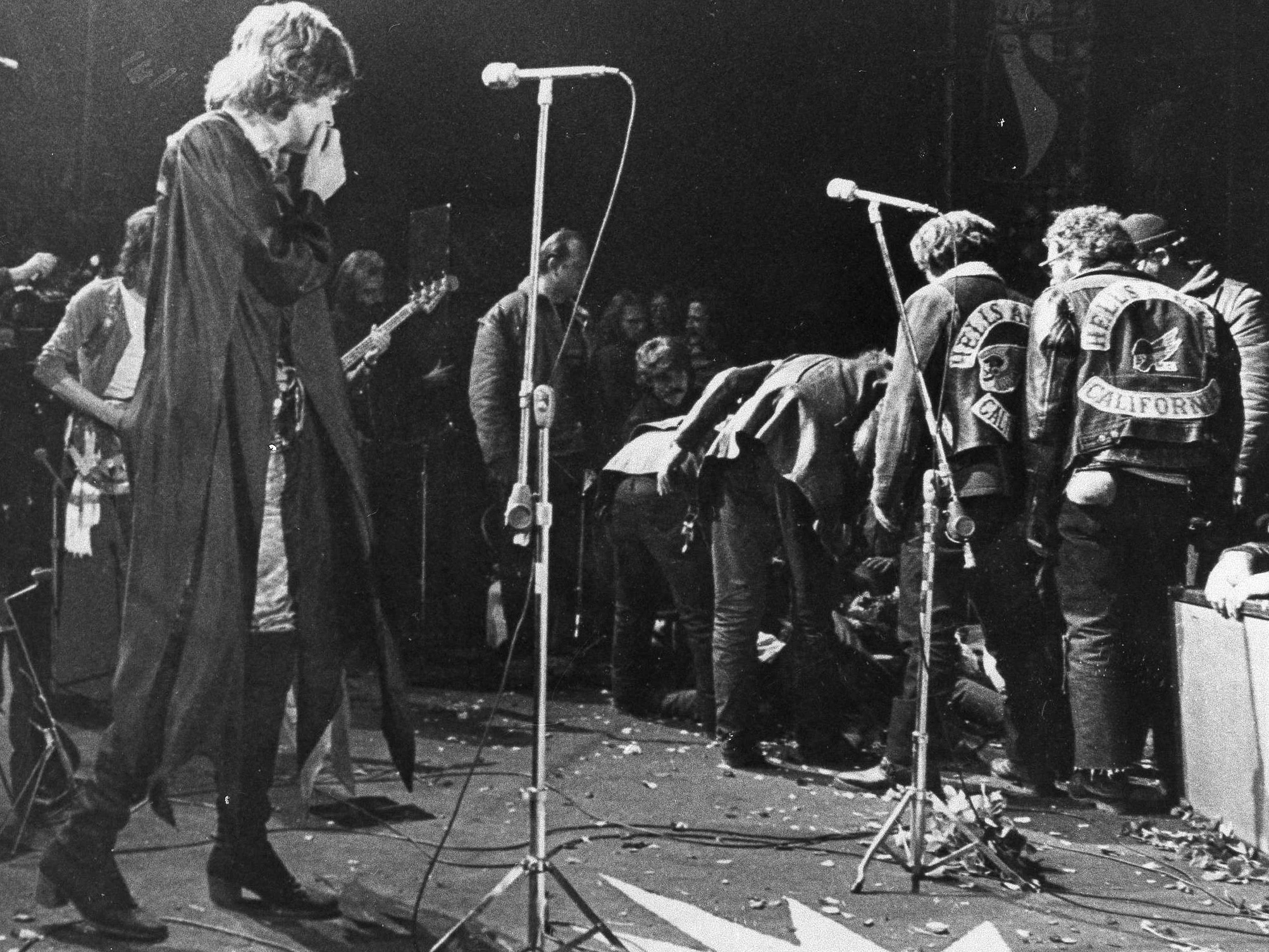
The Angels parked their prized choppers directly in front of the low stage. Whenever the tightly packed, suffocating crowd naturally surged forward and bumped the chrome, the bikers retaliated with indiscriminate, bone-crushing violence.
It didn’t matter if you were a fan or a famous rock star. When Jefferson Airplane took the stage, singer Marty Balin looked down and tried to intervene to stop an Angel from ruthlessly beating a fan. A biker stepped forward and knocked Balin entirely unconscious in the middle of their set. Backstage, the Grateful Dead—who had originally suggested the Angels for the gig—heard about the bloody, spiraling chaos, packed up their gear, and fled the site by helicopter before playing a single note.
Sympathy for the Devil
By nightfall, the air was thick with smoke, freezing cold, and boiling violence. The Rolling Stones finally stepped into the crosshairs.
Mick Jagger looked out at a churning sea of hysteria. Almost immediately, the violence flared again, completely halting the music. Jagger pleaded desperately into the microphone, his voice tinged with genuine panic: “Brothers and sisters… why are we fighting? Let’s just cool out.”
But the Angels were beyond listening. As the Stones launched into a brooding, hypnotic rendition of “Under My Thumb,” the simmering tension finally snapped.
In the crushing mass just feet from the stage stood eighteen-year-old Meredith Hunter, wearing a dapper, bright lime-green suit. High on amphetamines and trapped in the suffocating crush, Hunter violently clashed with the bikers. As the Angels swarmed him, raining down relentless punches, Hunter broke away, staggered backward, and reached inside his jacket.
He pulled out a long-barrel .22 caliber Smith & Wesson revolver.
In a flash of terrifying violence captured forever on 16mm film, Hells Angel Alan Passaro lunged through the dense crowd, caught Hunter’s arm, and plunged a hunting knife into the teenager’s back. Hunter went down in a brutal flurry of boots and blades. The Rolling Stones, oblivious to the grim reality that a murder had just occurred yards away from their feet, paused, restarted, and played out the rest of their set in a surreal trance.
Hunter wasn’t the only casualty of the speedway. By the time the sun rose on the debris-strewn wasteland, three other attendees were dead—two crushed in a hit-and-run, and one drowned in an irrigation canal during an LSD-induced hallucination.
The Hangover of a Generation
The tragedy was immortalized by filmmakers Albert and David Maysles in the chilling rock documentary Gimme Shelter. Watching the footage of a stunned Jagger staring blankly at the playback of Hunter’s murder in the editing room remains one of the most haunting images in music history. Passaro was later acquitted of the murder, with a jury ruling he acted in self-defense against the armed teenager.
Altamont wasn’t just a concert gone horribly wrong. It was a violent punctuation mark. It exposed the naive fragility of the hippie ethos, proving that without structure, “doing your own thing” could effortlessly devolve into brutal, primal chaos. When the 300,000 exhausted survivors trudged back to their cars on that freezing December morning, they left more than just trash in the dirt. They left the idealism of the 1960s behind for good.