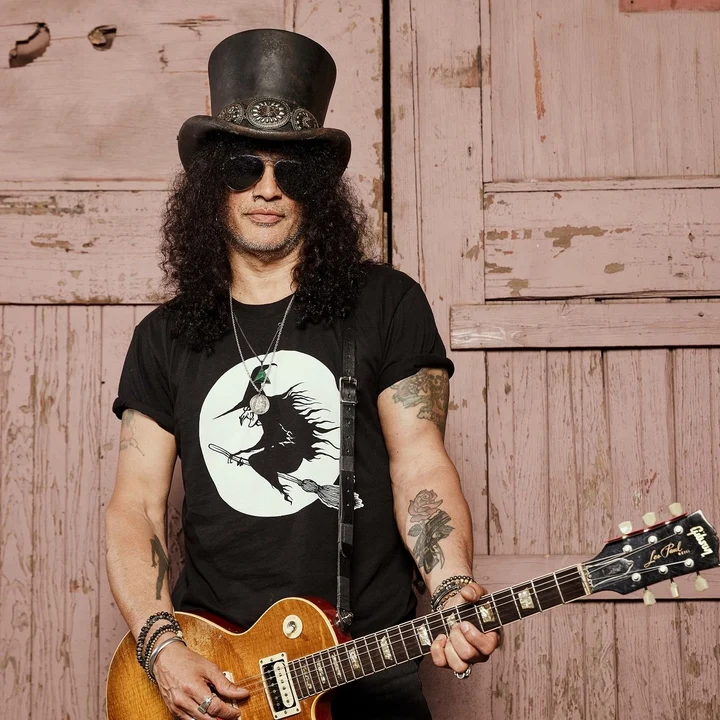
Slash never cared much about ego. Even at the height of Guns N’ Roses’ fame, he didn’t chase the spotlight the way other rock stars did. With his hair covering his face beneath a top hat and a Les Paul in hand, he preferred to let the music—and the chaos—speak for itself. But being one of the most recognizable guitarists of his era meant he couldn’t avoid the opinions of his peers, and not everyone was impressed.
By the late 1980s, Guns N’ Roses were exploding onto the scene with a dangerous energy that set them apart from the glossy hair-metal acts dominating MTV. They weren’t polished; they were raw. Appetite for Destruction wasn’t the kind of record parents wanted in their living rooms, but that only fueled its appeal. For fans, the danger was the point, and Slash embodied it every night—quiet, brooding, and larger than life with a bottle of Jack Daniels never far away.
The industry quickly took notice. Legends like Elton John embraced the band, even joining them onstage for “November Rain.” But not everyone welcomed them. One of the most telling encounters came with Prince, who, by then, was already one of the most innovative and untouchable artists in the world.
Slash recalled meeting him at the American Music Awards and being completely brushed off. “I met Lenny Kravitz, which was cool, but Prince blew us off,” he remembered. “He and his entourage just ignored us when we walked by. He didn’t say anything, and he probably didn’t know who we were. I don’t think we’re what he’d call good company, and I really didn’t care.”
It wasn’t that Slash was bitter—he simply recognized that they were on very different paths. Guns N’ Roses thrived on fire and chaos, burning brightly but briefly, while Prince was a relentless craftsman who always chased the next masterpiece. In 1987 alone, the year Appetite dropped, Prince had Sign o’ the Times under his belt and was already pivoting toward Lovesexy after shelving The Black Album for being “too dark.” His vision of artistry didn’t leave room for bands reveling in danger and excess.
In the end, the clash wasn’t personal—it was about perspective. Guns N’ Roses were the young outlaws rewriting the rulebook, while Prince was the seasoned genius who didn’t need to play by anyone’s rules. Their paths crossed only briefly, but that moment said everything about the divide between spectacle and artistry in the late ’80s rock world.