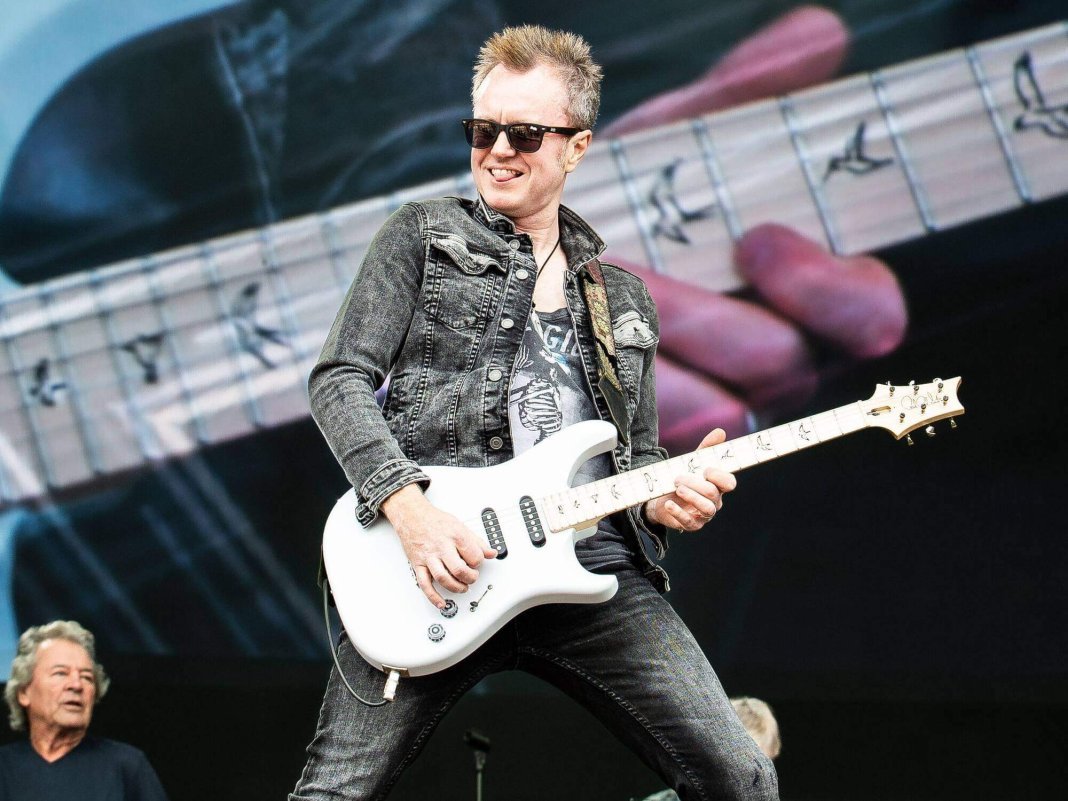
Deep Purple guitarist Simon McBride has pulled back the curtain on one of rock’s favorite illusions: the idea that a classic riff is automatically easy just because it is simple. In a new interview with Rob Cass of the dopeYEAH talk podcast, McBride said that songs like “Smoke On The Water” are often the hardest to play properly because their impact depends on restraint, feel, and precision rather than flashy technique.
McBride, who officially joined Deep Purple in 2022 as Steve Morse’s replacement, laughed off the rumor that he learned the band’s set in only 40 minutes before his first show. He said Deep Purple’s catalog is not overly complicated, which is exactly why it works so well. In his words, “Smoke On The Water” is basically “three chords,” and even songs like “Perfect Strangers” are only “two or three chords.” He added that he learned the material quickly because he trains his ear to pick things up fast, even though some parts still required careful work.
He also explained that getting inside the band’s classic guitar parts means adapting to how Deep Purple has evolved them over decades of live performances. McBride said he once followed the rumor that the guitar was panned left and the keyboards right on the original records, so he did the same while learning the songs — and realized how clearly he could hear Ritchie Blackmore’s guitar once he isolated it. But he noted that the band’s arrangements have changed over time, and when he tried to play things exactly as Blackmore once did, the band would often correct him by saying the song had already evolved.
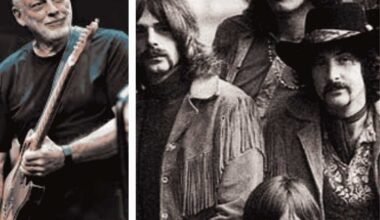
That, McBride said, is part of the real challenge: not trying to become a copy of anyone who came before him. He pointed out that Deep Purple’s guitar chair has been occupied by a towering list of names — Blackmore, Tommy Bolin, Joe Satriani, and Steve Morse — and said the pressure can tempt a player to imitate the legends instead of trusting his own voice. But McBride insisted the band did not hire him to be another Blackmore or Morse clone. He said Deep Purple wanted him for what he does naturally, and that was the key to getting comfortable. Don Airey, he added, was especially helpful, repeatedly telling him to drop the overthinking and “just be yourself.”
McBride said that mindset also helped him survive the nerves of his first Deep Purple show in Tel Aviv in May 2022. He explained that he normally does not get nervous before gigs because nerves usually come from being unprepared, and he is usually thoroughly prepared. But stepping onstage with Deep Purple after two or three years without a live performance — in front of a huge crowd — was still enough to make his stomach drop. For a brief moment backstage, he said, it hit him that this was no ordinary gig.
When asked to name the hardest song in the Deep Purple set, McBride doubled down on his original point: the simplest ones are the most brutal. He said “Smoke On The Water” is technically easy, but not easy to play well. The difference is in delivery, force, timing, and discipline. Guitarists, he said, often want to decorate the riff with vibrato or extra flourishes, but the magic of that song is its stark simplicity. The riff only works when it is played exactly as it is meant to be played, with no ego and no overthinking. That’s when the song detonates.
He then took the idea even further, arguing that technical complexity is often easier than simplicity. In his view, a lot of “hard” music is actually easier to fake than a supposedly simple classic, because the truly iconic material depends on feel, looseness, and human imperfection. He pointed to bands like Rage Against The Machine, the drumming of Queen’s Roger Taylor, and Charlie Watts of the Rolling Stones as examples of players whose slightly imperfect style became their signature sound. Perfect playing, he suggested, does not always mean better playing.
The interview also comes as Deep Purple prepares to release a new studio album, Splat!, on July 3 through earMUSIC. The album reunites the band with producer Bob Ezrin and has been described in the press release as the heaviest Deep Purple record in years. To support it, the band is also continuing a huge 2026 tour with 86 shows across 28 countries on three continents. Deep Purple’s legacy remains massive, with more than 120 million albums sold, a Rock And Roll Hall of Fame induction in 2016, and a reputation as one of the most influential bands in rock history.