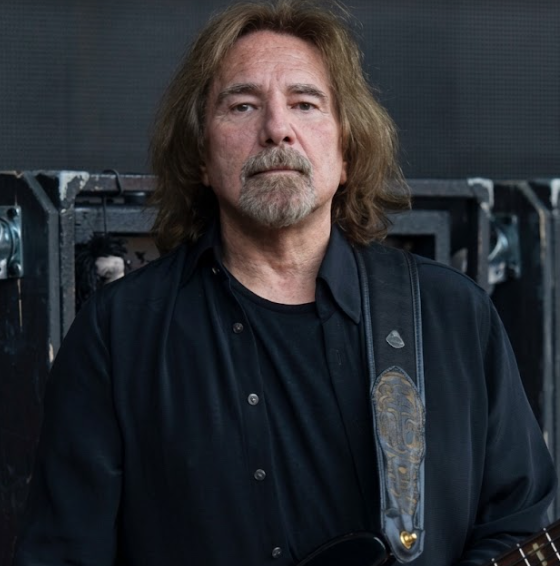
Heavy metal pioneer and founding BLACK SABBATH bassist Geezer Butler has opened up about the profound musical epiphany that convinced him to abandon the guitar and dedicate his life to the bass.
Appearing on the second episode of Fender’s new series Lowdown On The Low End—a digital show where iconic bassists sit down to swap war stories—Butler joined Foo Fighters bassist Nate Mendel to discuss his legendary career, the early days of Black Sabbath, and the instrument that defined his earth-shaking tone.
During the conversation, Butler singled out late Cream legend Jack Bruce as the ultimate catalyst for his musical evolution.
“The one player that totally showed me what you could do with a bass was Jack Bruce,” Geezer recalled. “When I went to see Cream, everybody was going, ‘You’ve gotta see this incredible guitarist. His name’s Eric Clapton.’ And back then, it was like they used to play little clubs around Birmingham. I stood right at the front of the stage. Jack came out with his Fender, and it was like, ‘What the hell?’ I couldn’t believe that people could do that with a bass. And that was it. I went, ‘That’s what I wanna do. I wanna play bass.'”
From Rhythm Guitar to Recruiting Ozzy Osbourne
Before forging the thunderous, downtuned rhythm section of Black Sabbath alongside drummer Bill Ward, Butler’s musical aspirations were aimed in a completely different direction.
Asked by Mendel about what initially drew him to the instrument and specifically the Fender Precision Bass, Butler revealed that he originally envisioned himself as a rhythm guitarist in the vein of his childhood heroes.
“I was a rhythm guitarist at first,” Geezer explained. “When I was 15, I had a group called The Rare Breed, and I used to think I was John Lennon and play rhythm guitar. Then the singer left, so we looked around and got this guy called Ozzy Osbourne in the band.”
As the lineup began to morph into what would eventually become Black Sabbath, the band found themselves lacking a formal bass player, leading to a serendipitous twist of fate and a crucial gear swap.
“Well, actually, we were looking for a drummer,” Butler continued. “We didn’t really think about bassists back then. And we asked Tony [Iommi] if he knew any drummers, and he says, ‘Well, it just happens Bill Ward’s here in the house.’ I only had a Fender Telecaster. I swapped me Fender Telecaster for a Precision bass. I thought, ‘Well, I’ve got a Fender, so the next thing I wanna get is another Fender.'”
The Indestructible Appeal of the P-Bass
For Butler, stepping onto a stage with a bass for the first time meant relying on the natural design and comfort of the Fender Precision Bass to accommodate his unique playing style. The choice quickly proved to be the perfect fit for his heavy, fingerstyle approach.
“Nothing had the balance of a P-Bass. It had perfect balance,” Geezer emphasized. “A lot of other basses, the neck was too heavy. So this was perfect ’cause I got fat fingers as well, so the wider neck is great for me. Plus there’s only two knobs, which is great for me.”
Butler would go on to utilize that raw setup to alter the course of rock history, anchoring timeless Black Sabbath masterworks like Paranoid, Master of Reality, and Sabbath Bloody Sabbath, while simultaneously serving as the primary lyricist behind generational anthems such as “War Pigs” and “Iron Man.”