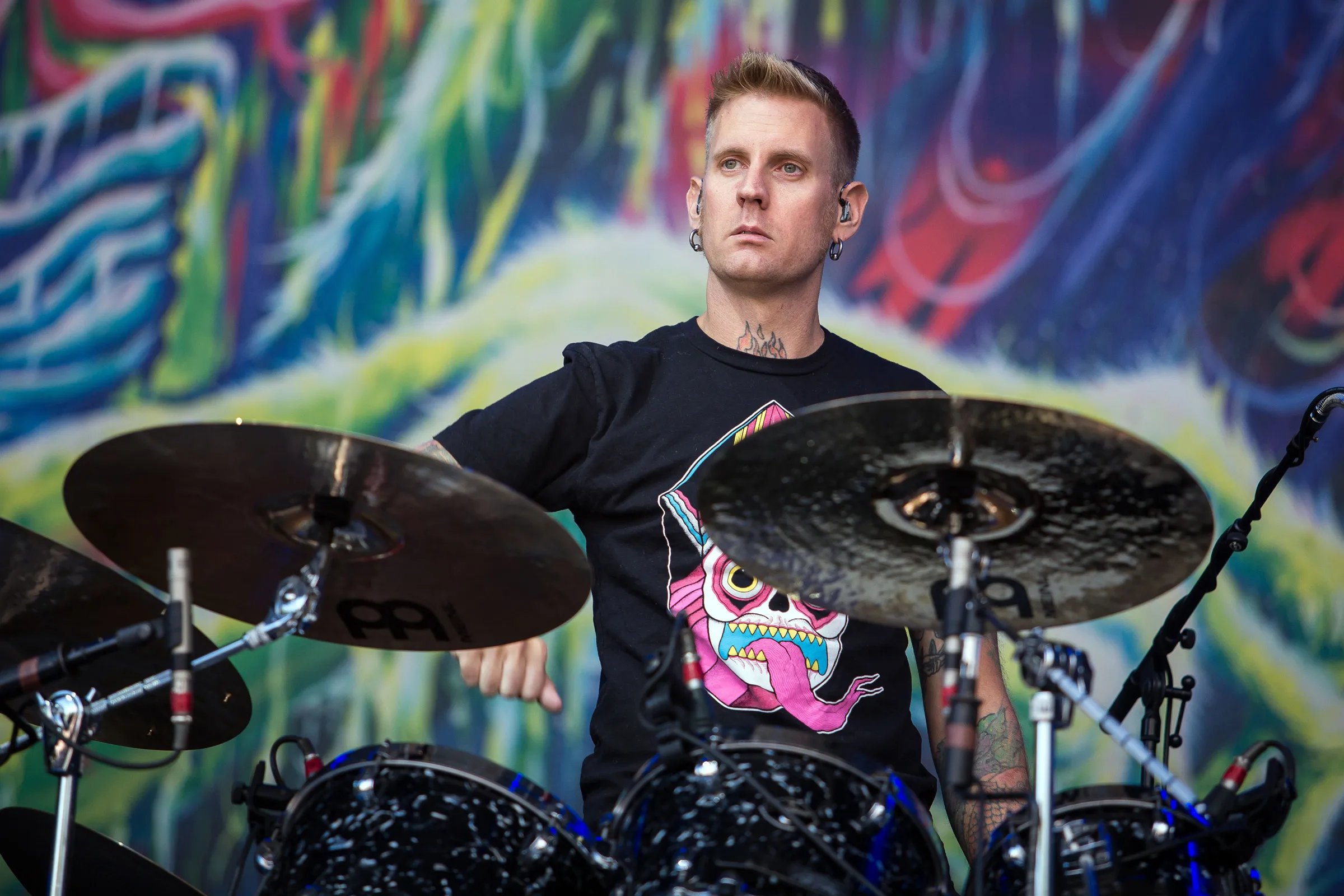
Brann Dailor has spent years balancing two roles inside MASTODON: the pounding force behind the kit and one of the band’s most recognizable voices. Since joining the vocal mix on 2009’s Crack The Skye, Dailor’s smoother, cleaner approach has helped widen MASTODON’s sound, giving the progressive metal band a more melodic edge without losing its heaviness. Now, he has taken that side of his artistry into even more personal territory with his cover of Chris Cornell’s “Dead Wishes” for KING ULTRAMEGA, the SOUNDGARDEN tribute project led by METAL ALLEGIANCE’s Mark Menghi.
Dailor said the Cornell cover was intimidating in a way very different from singing in MASTODON. Because the song leans into a more delicate, bluegrass-tinged feel and demands full Chris Cornell vocal power, he viewed it as a challenge outside his usual range. He compared the experience to taking on a monumental song like “Stairway To Heaven,” saying he wanted to approach it carefully and give it real attention. At the same time, the absence of drums in the project gave him room to focus entirely on the vocal performance rather than trying to sing while playing.
He also explained that the track gave him a chance to stretch beyond the way he normally sings in MASTODON, where his parts have to fit the band’s heavier and more structured style. On the tribute recording, he said he could simply open up vocally and explore Cornell’s nuances without worrying about locking in with a drum pattern at the same time. For Dailor, that made the project feel both liberating and daunting.
The offer to sing “Dead Wishes” also carried a personal emotional charge. Dailor said he brought the song home and shared it with his mother, a longtime fan of Chris Cornell and SOUNDGARDEN. He recalled that she immediately connected with Cornell’s work and would have been thrilled to hear him tackle one of Cornell’s songs. After her recent passing, that memory made the performance even more meaningful. Dailor said he pushed himself to do the song justice partly because he knew she would have loved it.
That sense of personal connection also shaped how Dailor approached the recording. He said he worked closely with engineer Miles Landrum at West End Sound to get into the right headspace. While he admitted he would have preferred to sing a SOUNDGARDEN song he knew better, he accepted the challenge of Cornell’s lesser-known solo material and focused on capturing its spirit rather than copying it mechanically. In the end, he said he felt comfortable with the result because it seemed honest and respectful to the song’s mood.
Outside of MASTODON, Dailor said he has recently been asked to contribute vocals more often, though not drums. He joked that it is easier for bands to invite him in for a vocal cameo than a drum appearance because most groups already have their percussion slot filled. He said he only agrees when he likes the song and feels he can add something worthwhile. He also admitted he has turned down material that did not fit him.
As for stepping all the way out front as a lead singer, Dailor said that idea is only appealing under certain conditions. He pointed to his synth project ARCADIA as an example of a setting where he can play a character rather than simply being himself. He said he could front a band if he were putting on a role, but not if the job required him to walk out as just Brann Dailor in a jacket and sing alone under the spotlight.
The interview then turned to the future of MASTODON, and Dailor delivered the biggest update: the band’s new album is complete. He said the record was finished only days earlier and that listeners would hear new music very soon. At the same time, he made clear that the process of making it was deeply difficult. The album was shaped by loss, turmoil, and grief, including his mother’s death, the band’s upheaval around Brent Hinds, and Hinds’ own death in August 2025. Dailor said those experiences are embedded in the songs and that the band has been holding onto the material for a long time already.
He added that some of the album’s skeleton was already in place two years ago, but circumstances around the band kept changing. Dailor said he had hoped this record might be free of loss and would allow MASTODON to return to more mythological, less personally painful subject matter. Instead, he said the band ended up dealing with another heavy emotional cycle, one that forced them to process what had happened in real time through the music itself.
Dailor also addressed the band’s new guitarist, Nick Johnston, who now has the difficult task of stepping into a role once defined by Brent Hinds. He said Johnston is not trying to be Hinds, and he emphasized that nobody ever could be. Still, Dailor praised Johnston’s playing, describing him as an excellent fit because of the way his style contrasts with Bill Kelliher’s heavier riff work. He said Johnston brings a proggier, more fluid approach, while also honoring the emotional shape of Hinds’ solos rather than copying them superficially.
That balance matters to Dailor, who said fans pay attention to the details and deserve to hear iconic solos played with care and respect. He compared that instinct to hearing Randy Rhoads parts close to the original when seeing Ozzy Osbourne, saying some of Hinds’ leads deserve the same kind of reverence. At the same time, he said Johnston is still adding his own flavor to the material, creating a combination that both preserves memory and moves the band forward.
When asked whether Hinds contributed anything to the new record, Dailor said no. He explained that the album is made entirely of new material and that by the end of Hinds’ time in the band, it had become difficult to get him into the rehearsal space. Dailor said the dynamic had shifted, with Hinds often wanting to do his own thing rather than work through riffs with the group. He stressed that he never saw this as a matter of anger, only as a sign that Hinds seemed increasingly detached from the process.
Dailor spoke about that period with regret but not bitterness. He said MASTODON had loved each other deeply for years and had built a rare long-term bond, especially for a band that kept the same lineup for so long. He suggested that the original version of the future he imagined would have included the four of them reconvening one day and laughing about the chaos. Instead, he said, that path is gone. Even so, he made clear that the remaining members are still committed to the band they started more than two decades ago.
He also reflected on the practical and personal differences between himself, Troy Sanders, Bill Kelliher, and Hinds. Dailor said the three of them tended to operate on a more regular schedule and preferred daytime rehearsals, while Hinds lived with a more chaotic rock-and-roll rhythm. He described Hinds as the kind of authentic wild card fans admired because he followed his own impulses, even when that made band life difficult.
Looking back further, Dailor said his work ethic came from a long history of drumming, including his early days in LETHARGY. He explained that he has played since childhood and has always felt a strong responsibility not to let fans down. That sense of discipline, combined with his urge to keep creating, is part of what keeps him invested in MASTODON even through hard periods. He said he loves not knowing what is around the corner creatively, and that surviving the struggle to get there is part of what makes the process worthwhile.