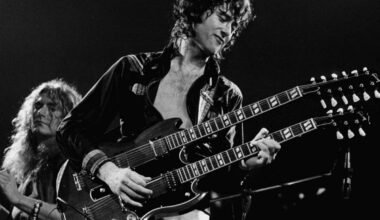

At 82 years old, Keith Richards is doing what he has always done — talking about the guitar with the casual authority of a man who has spent more time thinking about it than almost anyone alive. In a new interview with Guitar World, the Rolling Stones co-founder opened up about how arthritis has changed the way he plays, what modifications he has made to accommodate the condition, and the philosophy he now brings to every session with the instrument that has defined his life. What he said was not a lament. It was something closer to wisdom.
“Yes, I do play fewer notes — because I’m not as fast as I used to be,” Richards admitted plainly. “At my age, what I find most interesting about the guitar is you can compensate for certain disabilities and nimbleness and find other ways of getting around the problem. And it teaches you another thing — you never stop learning with the damn thing. I love it, and it’s my friend forever.”
That last sentence — it’s my friend forever — is the kind of thing that lands differently when you understand the full arc of the relationship it describes. Keith Richards did not just play the guitar. He built one of the most recognizable guitar sounds in the history of recorded music out of it. The open-G tuned five-string Telecaster called “Micawber.” The black 1960 Gibson ES-355 that has been on every Rolling Stones tour since 1997. The riffs for “Satisfaction,” “Jumpin’ Jack Flash,” “Brown Sugar,” “Start Me Up” — a catalog of rhythm guitar playing so distinctive and so deeply embedded in popular culture that Gibson recently described him as a guitarist whose absence from music history is simply impossible to imagine.
Richards was candid about the practical realities of playing with the condition. “Well, I do have arthritis and very large knuckles,” he said. “They don’t hurt, but it does get in the way sometimes. I’m going for a wider fingerboard for that reason.” He also admitted to being less diligent than he should be about using hand pumps during his pre-show warm-ups — a small but telling detail that humanizes a man who has spent six decades being mythologized as indestructible.
Richards described his current approach to the guitar with characteristic humor and warmth: “Honestly, I just look at my hands, and my hands look at me, and we say, ‘Well, let’s see what we can do today.’ And that’s the way I play guitar. I look at it and say, ‘We’ve got nothing else to do. Come here. I love you!’”
The arthritis has had real-world consequences beyond just technique. Reports earlier this year indicated that Richards was unable to commit to the physical demands of a long stadium tour, contributing to the Rolling Stones canceling their planned 2026 UK and European stadium run. A band representative told Variety in December 2025 that they would return to the stage “when they’re good and ready,” making clear that retirement was not on the table — just patience.
But the creative life of the Rolling Stones is very much ongoing. The band has nearly finished a new studio album with producer Andrew Watt, focusing their energy on recording rather than touring for the time being. Watt — who produced Hackney Diamonds, the band’s acclaimed 2023 comeback record which earned them a Grammy — gave Rolling Stone magazine a characteristically guarded update: “I’ve said it before, but it’s like working for Batman. When the tongue is up in the air, you just go. I can say we did some recording together, but that’s all I can say.” Richards’ son Marlon was more forthcoming, suggesting that a follow-up album was well underway — and that the Grammy win had given everyone in camp a shot of motivation.
The Guitar World interview coincided with another significant development in Richards’ world. Gibson Custom recently unveiled two limited-edition signature recreations of Richards’ iconic black 1960 ES-355 — the guitar he first used in 1969 during sessions for Sticky Fingers and Exile on Main Street and has played on every Stones tour since 1997. Only 50 of the Collector’s Edition versions — signed by Richards on both the f-hole label and the back of the headstock — were produced, alongside a further 100 signed label editions. Each was handcrafted in Gibson’s Custom Shop in Nashville using advanced 3D scanning, period-correct materials, and Murphy Lab hand-aging to mirror every detail of the original.
Richards spoke about the collaboration with characteristic directness: “This is my standard-tuning six-string. This is the other side of my thing. My six-string stuff has always been, you know, a great Gibson — that’s where I feel the most comfortable. And also with the sound. Put it through just about any amp, and it will sound the way you want it, because this has so much more room for expression.” On the honor of having a Gibson built in his name, he added: “As a guitar player, I’m incredibly honored that Gibson would do this. For a guitar player, there’s nothing like having a Gibson named after you. There I am, and there it is.”
That combination — a health condition limiting what he can do physically, and a guitar company immortalizing what he has already done — creates a portrait of a musician at a particular crossroads. Not the end. Not diminishment. Something more nuanced than either of those words. Richards has always played fewer notes than most guitarists. His genius was never about speed or complexity. It was about feel, timing, and the ability to make a simple riff sound like the most important thing happening in the world at that exact moment. Arthritis slows the fingers. It does not touch that.
The Rolling Stones have been playing music for over six decades. They have outlasted trends, personnel changes, tragedies, and more chaos than most bands encounter in a single year. Keith Richards looking at his arthritic hands each morning and saying “well, let’s see what we can do today” is not a story about decline. It is a story about a man who has been having that same conversation with his guitar since 1962 — and still has not run out of things to say.