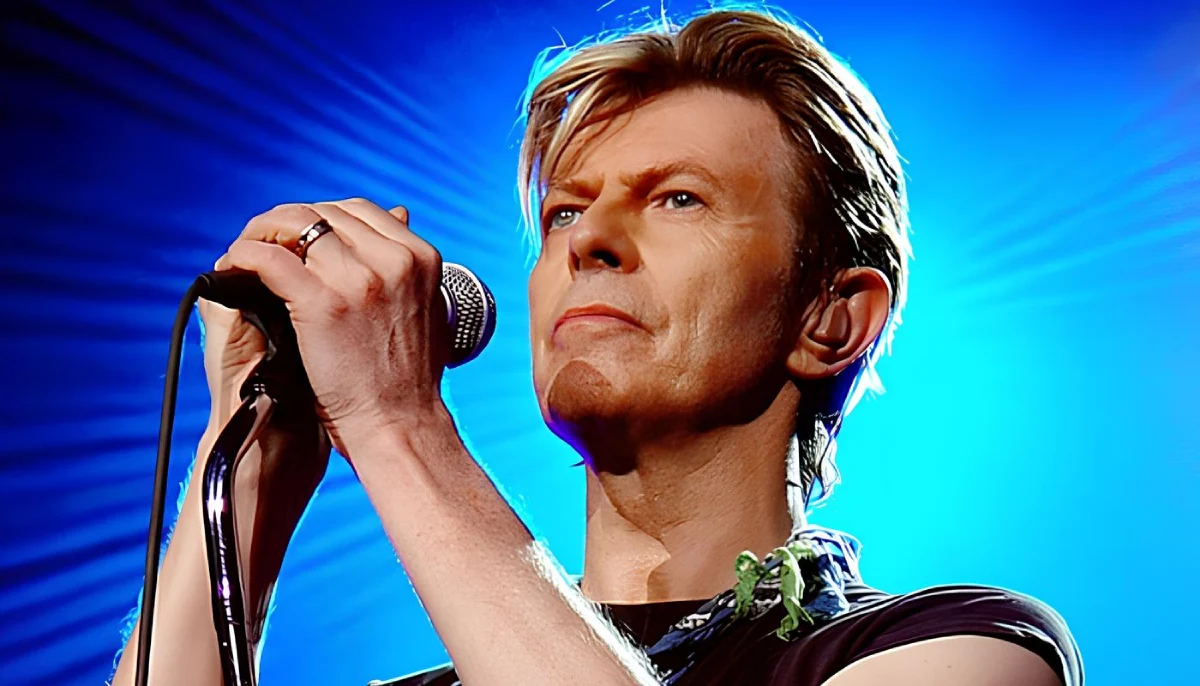
It’s a quote that lands with the quiet confidence of a man who had thought about it deeply — and laughed at himself while saying it. In a 2002 conversation with NPR’s Terry Gross on Fresh Air, David Bowie explained why the denim-and-T-shirt, working-man image of rock authenticity never sat right with him: “I didn’t feel comfortable in that, because I didn’t feel like one of the working men. I mean, I could never be a blue collar-y kind of Springsteen-y type artist because I don’t believe I am that, and I don’t believe I could ever represent that, and it is merely representation.”
That last phrase — it is merely representation — is the key to everything. Because Bowie wasn’t dismissing Springsteen. He was making a distinction about artistic honesty. To pretend to be the Everyman when you are anything but, Bowie argued, is just as much a costume as Ziggy Stardust — except less honest, because at least Ziggy knew it was a costume.
The Bowie-Springsteen story is one of rock history’s most fascinating near-misses. In 1973, Bowie discovered Springsteen via his debut album Greetings from Asbury Park, N.J. and was so taken by it that he decided to cover not one but two songs from it. He covered “Growin’ Up” during the early sessions for Diamond Dogs with Ronnie Wood on guitar, and later cut “It’s Hard to Be a Saint in the City” during the sessions for Young Americans at Sigma Sound Studios in Philadelphia.
Then came the meeting. On November 25, 1974, Bowie invited Springsteen to Sigma Sound to hear the sessions — and arrived an hour late, by his own admission, “out of my wig.” Producer Tony Visconti recalled the encounter vividly: “David was quite taken by meeting Bruce. We played ‘Saint’ to him and he kept a poker face the whole time. He said nothing when it was finished. David took him into another room for a private chat. By the time Bruce left, he was more pleasant and said his goodbyes to the rest of us. David and I never worked on ‘Saint’ after that.”
According to a journalist present that night, Springsteen left the studio at 5am without ever hearing Bowie’s version — Bowie had chickened out of playing it, feeling it wasn’t ready. A Bowie-Springsteen collaboration that nearly happened, didn’t — and the song sat in a vault for 15 years before surfacing on the 1989 Sound + Vision box set.
Bowie’s feelings about Springsteen were, characteristically, complex. He once said he “hated him as a solo artist, when he came on and did this Bob Dylan thing. It was awful, so cringe-making. He’d sit there with his guitar and be folky, have these slow philosophical raps in between the songs. As soon as the band came on, it was like a different performer — and he was just marvelous.”
In a 1979 radio session, Bowie introduced Springsteen’s “It’s Hard to Be a Saint in the City” saying: “Here is a great writer and I don’t like what he is doing very much now. I loved this album when it came out. After I heard this track I never rode the subway again. It really scared the living ones out of me.”
And in 1985 — just a month after Live Aid — Bowie was caught on tape in a London recording studio doing a full, affectionate impersonation of Springsteen in the vocal booth, alongside impressions of Bob Dylan, Tom Waits, Lou Reed, Iggy Pop and Neil Young. He could do Springsteen. He just chose not to be him.
The Verdict: Respect Without Imitation
What the quote really reveals is Bowie’s defining artistic philosophy — that authenticity isn’t about stripping down to a T-shirt and jeans and pretending to be ordinary. He knew there was no point trying to look at his music through the same lens as Springsteen. “The Boss” had a rough-and-tumble way of looking at the world, and even though both drew from Bob Dylan, Bowie had a far more theatrical and abstract approach.
And Springsteen, for his part, always knew what he owed Bowie. When Bowie died in January 2016, Springsteen told his crowd in Pittsburgh: “Not enough people know it, but he recorded our music way, way, way back in the very beginning, 1973. He covered some of my music and he was a big supporter of ours.” He then tore into a blistering version of “Rebel Rebel.”
Two of rock’s greatest artists — one the voice of the heartland, one the alien of Brixton — who admired each other across a fundamental difference. Bowie laughed when he said it, and that laugh tells you everything. He wasn’t putting Springsteen down. He was simply, finally, completely comfortable being the one thing Bruce Springsteen could never be either.
Himself.