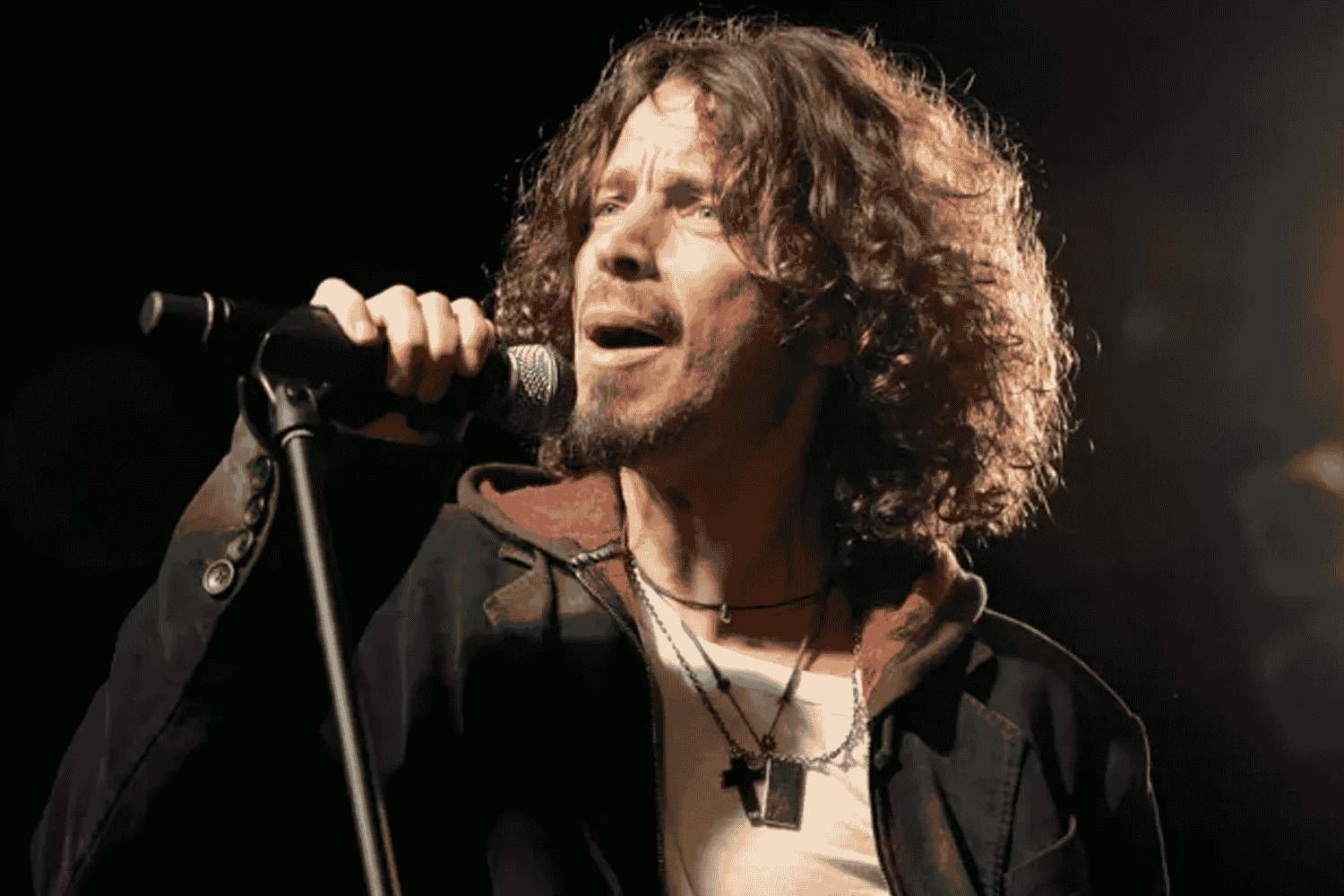
Chris Cornell — the late, legendary vocalist best known for his work with Soundgarden and Audioslave — had one rock star he openly admitted he couldn’t match when it came to sheer stage presence and stamina, even though he otherwise admired many performers. In a candid radio interview years before his passing, Cornell spoke about watching The Rolling Stones’ Mick Jagger and acknowledged that Jagger’s live energy was something he simply couldn’t replicate.
Cornell’s own vocal power and intensity were legendary: his multi-octave delivery and emotional force helped define grunge in the early 1990s and made him one of rock’s most expressive voices. However, he drew a distinction between singing and the other, equally necessary elements of commanding a stage. He told KROQ that after seeing Jagger in Scorsese’s Shine a Light documentary, he realized just how different their approaches were. “When I saw Scorsese’s Shine a Light with The Rolling Stones; I was on tour when I saw that… I’m watching Mick Jagger… thinking, ‘I can’t do that now. I don’t even try to do that,’” Cornell said, referring to the Stones frontman’s ongoing ability — even in his mid-60s — to move and perform with boundless energy.
Cornell wasn’t diminishing his own talent — his voice and presence had influenced an entire generation — but he was honest about the type of physical performance Jagger brought to every show. Jagger’s iconic movements — from the rooster walk to explosive stage antics spanning more than five decades — set a different standard for what it means to command a crowd beyond vocal prowess alone.
The two men came from very different rock worlds. Jagger’s roots are in the classic blues-inflected rock of the early Rolling Stones era, and his performances have always blended athletic motion and swagger with vocal delivery. Cornell, on the other hand, built his reputation around sheer vocal command and emotional intensity — often erupting into soaring, cathartic howls that defined tracks like “The Day I Tried to Live” and “Black Hole Sun.”
Cornell clearly had respect for the mechanics of Jagger’s craft — the blend of blues roots, showmanship, and decades of relentless touring — but he admitted that trying to emulate that kind of overall performance just wasn’t something he could or wanted to do. “He put in the road miles a lot more… still hitting high notes he did back in the late 1960s,” Cornell said, adding that his own focus was different, and that was okay.
Despite Cornell’s humility about his own physicality on stage, his legacy remains enormous. His voice, songwriting, and emotional intensity helped elevate alternative rock in the 1990s and beyond — and while he may have viewed Jagger’s stage persona as out of his league, fans continue to celebrate Cornell’s unique approach to performance.
Cornell passed away in 2017 at age 52, but his influence persists across rock, alternative, and even metal circles — a reminder that impact isn’t defined by a single type of performance, but by the emotional connection between artist and audience.