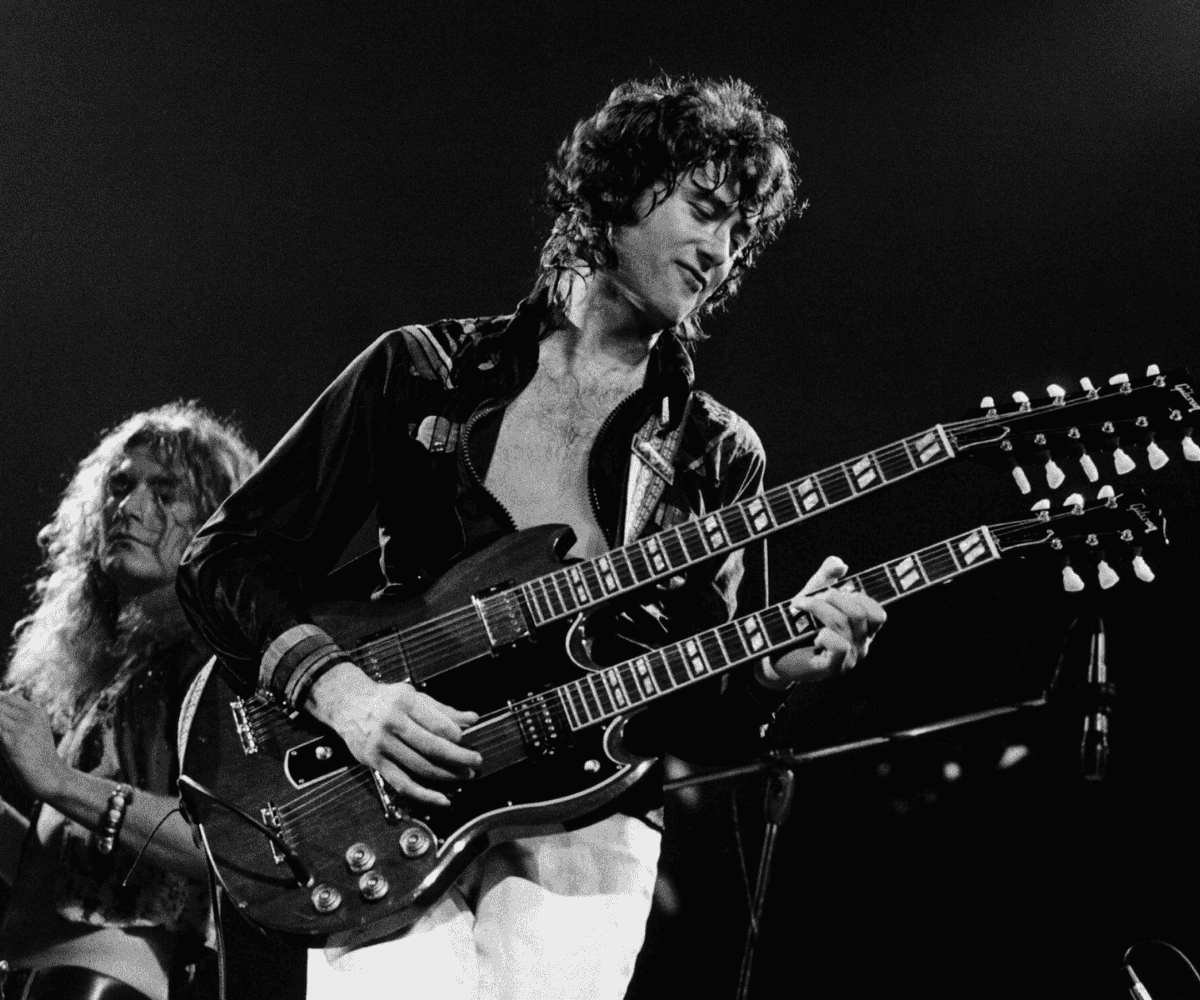
Before Jimmy Page became the architect of Led Zeppelin’s thunderous sound, before his riffs changed rock forever, he was just a kid in Surrey—one who stumbled across a beat-up guitar that would shape the rest of his life.
Page didn’t grow up planning to be a guitar hero. As he tells it, the guitar found him. When his family moved into a new home in Epsom, the previous owners left behind an old, abandoned instrument. “Nobody seemed to know why it was there,” Page recalled. But he picked it up—and never let it go. That dusty guitar sparked something deeper than curiosity. It triggered an obsession.
“I didn’t want to do a carbon copy of B.B. King,” Page once said. “But I really love the blues… I just wanted to make my own contribution in my own way.” And that’s exactly what he did.
Like so many British musicians of his era, Page’s world cracked open when he discovered Muddy Waters. In post-war England, Waters wasn’t just a musician—he was a mystery. His music was hard to find, often buried deep in dusty record shops or heard briefly through grainy American broadcasts. That scarcity only added to his magic. When Page finally did get his hands on a Waters recording, it hit him like lightning.
“Even if you were listening to the American Forces Network… they weren’t playing Muddy Waters,” he said in a 2014 interview. But once he heard him, he was hooked.
Page was especially haunted by one track: “Standing Around Crying,” a 1952 recording featuring the eerie harmonica of Little Walter. “As much as there’s technical playing, there’s a whole atmosphere to the performance that really got me,” he said. “That was just so eerie. Oh, my goodness. I get the chills even thinking about that one.”
It wasn’t just the notes Muddy Waters played—it was the emotion behind them. Page didn’t want to mimic him; he wanted to channel that same feeling. He wanted his guitar to tell stories, to ache, to howl. And when you hear the haunting orchestration of a Zeppelin track like “Kashmir,” you can feel that same chill Page described—just modernized and amplified for a different world.
Page’s influences stretched from British skiffle to American blues, but it was Muddy Waters who gave him the spark. “I wanted to have my own approach to what I did,” he said. “But the blues had so much effect on me.”
That effect still echoes through every Zeppelin riff, every wail, every soaring solo. And it all started with one battered guitar… and one song that made Jimmy Page realize how powerful music could really be.