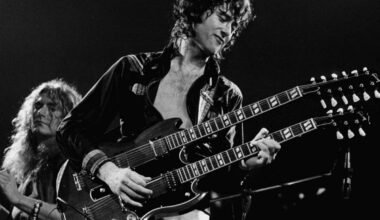

Few bands have reshaped rock music quite like Pink Floyd. With their ambitious sonic experiments and trailblazing concepts, the group became one of the most influential forces in modern music. But behind their success was a volatile mix of creative minds, each bringing something vital—and sometimes conflicting—to the table. According to David Gilmour, though, only one member of the band was truly irreplaceable.
Gilmour joined Pink Floyd in 1967 during a turbulent time. The group was then led by Syd Barrett, the psychedelic visionary behind their early work. But Barrett’s increasingly erratic behavior, fueled by drug use and mental health struggles, made him unreliable. Gilmour was brought in to support—and ultimately replace—Barrett, whose departure marked the end of Floyd’s first chapter.
From there, a power struggle emerged. Roger Waters stepped up as the band’s main creative force, guiding them through their most commercially and artistically successful era, including the landmark The Dark Side of the Moon. But with success came tension. Waters and Gilmour clashed repeatedly, and their friction became as infamous as their music. By the mid-1980s, Waters left the band, disillusioned and convinced that Pink Floyd could not continue without him.
But continue it did—under Gilmour’s leadership. Yet even with Barrett and Waters gone, the band’s long-standing internal drama gave rise to a perception that no one in Pink Floyd was truly essential. Everyone, it seemed, could be replaced. Everyone, except Richard Wright.
In Gilmour’s view, Wright—the band’s original keyboardist—was the soul of Pink Floyd. He was pushed out of the band in the early ’80s under pressure from Waters, but later returned and played on every Floyd album except The Final Cut. His contributions were integral to the group’s most iconic works.
Celebrating what would have been Wright’s 81st birthday, Gilmour paid tribute to his late bandmate, calling him “my musical partner and my friend.” He added, “In the welter of arguments about who or what was Pink Floyd, Rick’s enormous input was frequently forgotten. He was gentle, unassuming and private but his soulful voice and playing were vital, magical components of our most recognised Pink Floyd sound.”
Wright’s impact is especially evident on tracks like Echoes—a song Gilmour refuses to play live without him—as well as The Great Gig in the Sky and Us and Them, two of The Dark Side of the Moon’s defining moments. It’s no wonder The Final Cut, the only album without Wright, is often viewed as one of the band’s weakest.
Though Pink Floyd thrived on creative tension, Gilmour made it clear: Richard Wright wasn’t just another member. He was the heart of the band—quiet, irreplaceable, and deeply missed.