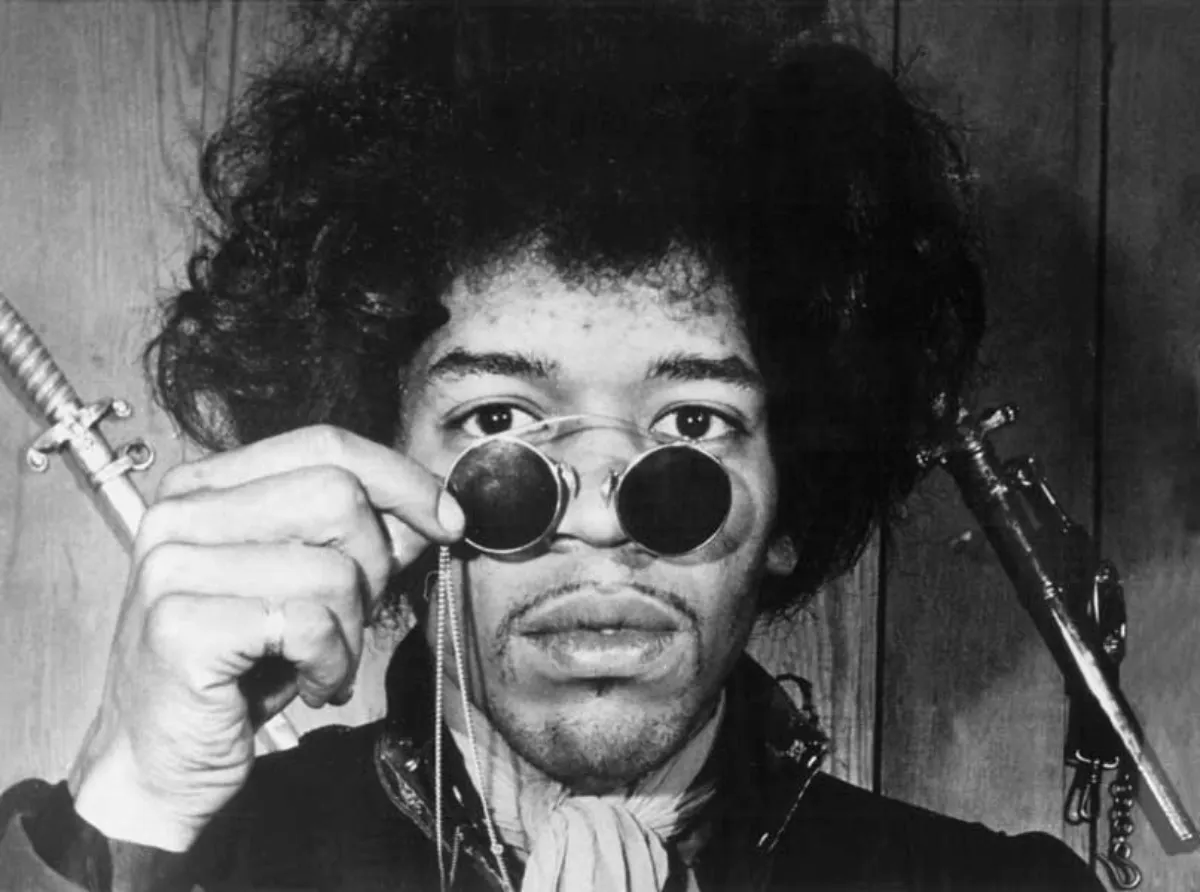
Psychedelic rock as we know it didn’t quite exist when Jimi Hendrix was alive. Sure, the seeds had been planted — swirling lights, fuzzed-out guitars, mind-bending lyrics — but in Hendrix’s eyes, much of it was just style over substance. For him, early attempts at acid rock felt hollow, and he wasn’t shy about calling it out.
“Here’s one thing I hate, man,” Hendrix once said. “When these cats say, ‘Look at the band. They’re playing psychedelic music!’ All they’re doing is flashing lights on them and playing ‘Johnny B. Goode’ with the wrong chords. It’s terrible.”
It’s a biting quote, and fans of bands like early Pink Floyd may bristle at the comment. But Hendrix wasn’t entirely off base. Even Pink Floyd’s own members have expressed regret over their directionless early years. Roger Waters, never one to sugarcoat things, once dismissed their debut album The Piper at the Gates of Dawn, saying: “We were laughable. We were useless. We couldn’t play at all, so we had to do something stupid and ‘experimental’.”
For Hendrix, who was already pushing the guitar into uncharted territory with surgical precision, the chaotic meandering of early psych bands probably felt like a half-baked imitation of innovation. It’s no surprise he kept his distance from the scene—at least in its earliest incarnation.
But had Hendrix lived a few years longer, his view of Pink Floyd might have changed.
Because something happened to the band after Syd Barrett faded from view and David Gilmour stepped in fully: the music matured. The aimless experimentation gave way to towering concepts, precision musicianship, and a signature tone that became the heartbeat of Dark Side of the Moon, Wish You Were Here, and The Wall. Gilmour’s guitar — lyrical, aching, and unmistakably human — became the centerpiece.
It’s hard not to wonder: would Hendrix, the ultimate guitar visionary, have been moved by the haunting bends and soulful phrases of Gilmour in his prime?
Gilmour certainly admired Hendrix. He was among the first in London to see Hendrix perform in 1966, long before any records were released. “I saw him at a club in South Kensington,” Gilmour later recalled, “and went to the shop the next day to buy his album — only to find out he hadn’t put anything out yet.”
Gilmour’s influence extended far beyond Pink Floyd, too. Pete Townshend — known for keeping creative control close to the chest — made an exception for Gilmour, collaborating with him in a rare studio partnership. “I was dumbstruck,” Gilmour said of the experience. “But [Pete] said he was having difficulty writing music, but had loads of words. I sent over two or three tracks and he came back with lyrics.”
For Gilmour, working with Townshend was a full-circle moment. “Pete has always been one of my heroes,” he said. “When I was very young, I hitchhiked from Cambridge to London to see him play at the Marquee Club. It was the very beginning of The Who. He is incredible.”
Hendrix may have scoffed at the flashy psych imitators of his time, but with Gilmour, he might’ve found a kindred spirit — a player who, like him, used the guitar not just to impress, but to speak.