
For countless kids discovering music, there’s a moment when the dream crystallizes: to be just like the artists they idolize. Whether it’s air-guitaring in front of the mirror or obsessively practicing an instrument, the fantasy is real—and for a young Mark Knopfler, it was no different.
Born in 1949, Knopfler came of age during one of music’s most transformative decades. The 1960s delivered rock and roll, psychedelia, and blues into living rooms around the world—and straight into the heart of a teenager in Newcastle. From early on, Knopfler knew this wasn’t just a passing phase. Music was his future.
He started gigging locally as a session guitarist at just 16, sharpening his skills in the clubs and pubs of northern England. But success wouldn’t come quickly. While the fire burned early, Knopfler spent years refining his technique and sound before forming Dire Straits in 1977 with his brother David. From there, it was a slow but steady climb to the top, and by the 1980s, they were one of the biggest bands on the planet with hits like Sultans of Swing, Money for Nothing, and Walk of Life.
Much of Knopfler’s style—clean, melodic, and deceptively complex—can be traced to the musicians who first lit the fuse. Speaking with Absolute Classic Rock, he opened up about the artists who made him want to pick up a guitar in the first place.
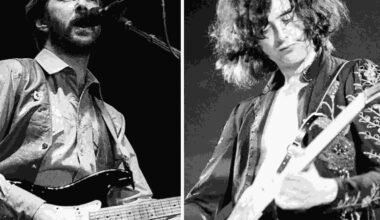
“They’re all so different,” he said of his influences, but three names stood out. First was Eric Clapton, specifically his work in John Mayall’s Bluesbreakers, a seminal British blues outfit. “I grew up wanting to be in a blues band like Eric,” Knopfler admitted. That sound—the sharp bends, the emotional weight—clearly left its mark.
Another Mayall alumnus made Knopfler’s list: Peter Green, the brilliant, haunted founder of Fleetwood Mac. Green’s soulful phrasing and minimalist approach helped shape the blues-rock landscape, and his influence can still be heard in Knopfler’s more introspective playing.
But perhaps the most heartfelt mention was reserved for Jeff Beck. “I must say,” Knopfler added, “Jeff Beck, he’s a tremendous loss.” Beck’s genre-bending genius and expressive style pushed the electric guitar into uncharted territory—something Knopfler, with his own subtle innovation, clearly admired.
Though the rock world continues to mourn Beck’s passing, his legacy—and those of Clapton and Green—live on in the hands and heart of Mark Knopfler. Their fingerprints are all over his sound, a blend of British blues, fingerpicked finesse, and unshakable soul.

Michael Thomas
Michael Thomas is a music historian obsessed with the '70s and '80s rock scene. He collects vinyl and argues about Led Zeppelin daily.