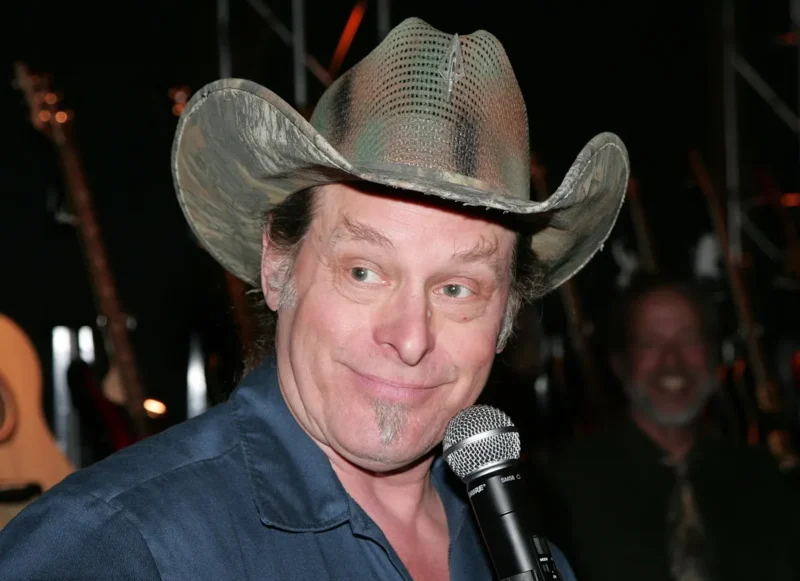
Ted Nugent has never been known for subtlety, and when he speaks with conviction, he speaks in capital letters. That was very much the case when the outspoken rocker recently turned his attention to YUNGBLUD, offering an unfiltered, old-school endorsement that reads less like praise and more like a passing of the torch.
In Nugent’s telling, YUNGBLUD represents something dangerously rare in modern rock music: raw, unpolished, confrontational energy. The kind that doesn’t ask permission. The kind that once defined the genre. Referring to him as “the real McCoy,” Nugent framed YUNGBLUD not as a trend-chasing pop-punk figure, but as a direct descendant of rock’s most ferocious architects — James Brown, Chuck Berry, Little Richard — artists who didn’t just perform music, but attacked the stage with it.
What makes Nugent’s comments particularly striking is the company YUNGBLUD now keeps. According to Nugent, the young British artist has been working closely with Aerosmith legends Steven Tyler and Joe Perry — a collaboration that immediately elevates the conversation beyond hype. Nugent revealed that he had been texting back and forth with Tyler and Perry, both of whom reportedly saw something deeply familiar in YUNGBLUD. Not just talent, but attitude. Instinct. That unteachable sense of danger that defined rock’s golden era.
Nugent’s language is telling. He doesn’t describe YUNGBLUD as polished, refined, or calculated. He calls him a “screamer” and a “squaller” — words rooted in blues, soul, and early rock ’n’ roll. Artists who screamed didn’t do it for effect; they did it because the music demanded it. Nugent sees that same compulsion in YUNGBLUD, a sense that the performance is survival, not presentation.
Perhaps the most revealing moment in Nugent’s statement comes when he recalls Tyler’s words: “This guy’s just like us.” That single sentence carries enormous weight. Aerosmith emerged from a generation where rock music was rebellious by nature, where authenticity wasn’t curated but lived. To be recognized by Tyler and Perry as one of their own suggests that YUNGBLUD’s intensity isn’t an act — it’s a mindset.
Nugent goes even further, framing YUNGBLUD as evidence that rock’s primal spirit hasn’t gone extinct. In an era dominated by algorithms, genre-blending playlists, and carefully engineered personas, Nugent sees hope in an artist who still embodies “piss and vinegar” — the reckless hunger that once made rock music dangerous, sexy, and culturally disruptive.
This isn’t the first time YUNGBLUD has been positioned as a bridge between generations. His open admiration for classic rock, punk, and glam, combined with his confrontational stage presence and emotional volatility, has earned him respect from veterans who rarely hand it out. But Nugent’s endorsement is different. It’s not polite approval. It’s visceral recognition.
For Nugent — a figure who has spent decades railing against anything he views as watered-down or inauthentic — to declare that the spirit of Chuck Berry and Little Richard is “alive and well” in YUNGBLUD is about as strong an endorsement as modern rock can receive. It suggests that beneath the eyeliner, the accent, and the new-generation aesthetics, YUNGBLUD is tapping into something ancient and volatile.
In Nugent’s eyes, rock doesn’t survive through nostalgia tours or legacy branding. It survives through artists who mean it. Who sweat, scream, provoke, and refuse to be tidy. And in YUNGBLUD — especially as he collaborates with icons like Steven Tyler and Joe Perry — Nugent sees proof that the bloodline isn’t broken yet.
Rock may have aged. Its pioneers may be fewer. But if Nugent is right, the fire hasn’t gone out. It’s just wearing a different name — and screaming just as loud.