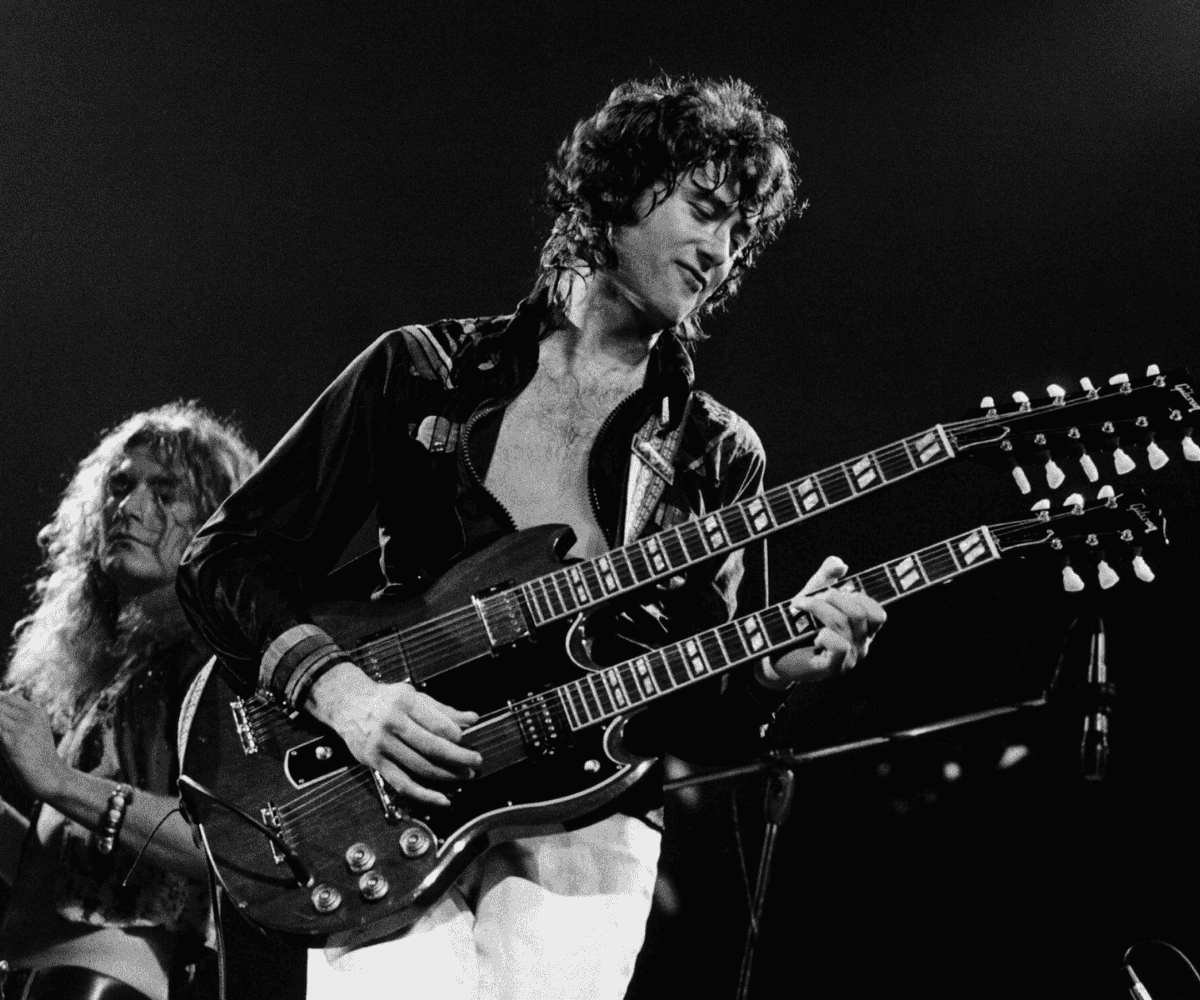
Keith Richards once summed up Led Zeppelin in his famously blunt style: “To me, Led Zeppelin is Jimmy Page if you wanna cut the story short.” While that line brushes aside the powerhouse vocals of Robert Plant, the thunder of John Bonham’s drums, and the intricate musicianship of John Paul Jones, there’s a certain truth to it. Page wasn’t just the guitarist—he was the architect of Zeppelin’s mystique.
There’s something haunting and elemental about Page’s guitar playing. It has an arcane edge that made Led Zeppelin feel not just heavy, but mythical. Some, like Eddie Van Halen, later criticized his technique as “sloppy,” but that critique misses the point. Page’s brilliance wasn’t about polish—it was about depth, atmosphere, and a raw, emotional energy that captured the chaos and curiosity of the 1970s.
But what made his work even more remarkable was its deep foundation in the past. Led Zeppelin sounded like nothing else at the time, yet if you dissect their songs, you’ll find the fingerprints of the blues all over them. Critics and copyright lawyers may have seen this as borrowing; Page saw it as paying tribute to the roots of rock and roll. He wasn’t hiding his influences—he was elevating them.
That philosophy is encapsulated in the riff that changed everything: ‘Whole Lotta Love.’ On the surface, it’s a simple blues lick, but Page transformed it into something colossal. The familiarity of the finger shapes is part of what makes it hit so hard—it feels grounded, yet revolutionary. Scientists have even suggested that what makes a riff unforgettable is the fusion of the unexpected with the recognizable. That’s exactly what Page nailed.
Reflecting on the track, Page once told Total Guitar: “That was clearly going to be the track that everybody was going to go to, because that riff was so fresh—and it still is. If somebody plays that riff it brings a smile to people’s faces. It’s a really positive thing.”
For Page, riffs like ‘Whole Lotta Love’ don’t just define a band—they become cultural touchstones. He believed this one would outlive trends, and he was right. But the song goes well beyond that iconic riff. Its swirling middle section—noisy, psychedelic, unpredictable—was Page’s vision for what Zeppelin could be: a band unafraid to experiment. And he fought to keep that section intact.
“I knew with ‘Whole Lotta Love’ that there weren’t going to be any edits,” he said. “I insisted that they kept the middle section in it, which of course they didn’t like, but they had to do it.” With this win, Page pushed Zeppelin’s sound even further into new territory, blending blues roots with cosmic ambition.
In the end, it worked because it captured something timeless. Art often absorbs the world around it before reflecting it back. Aristotle put it best: “The purpose of art is to represent the meaning of things. This represents true reality, not external aspects.” Jimmy Page, knowingly or not, embodied that idea through a guitar riff that reflected both the present and the past—melding blues tradition, psychedelic exploration, and the heaviness of modern life into one unforgettable sound.
And while Zeppelin was born out of London and not the post-industrial gloom of Birmingham, Page’s guitar spoke for a generation weighed down by the heavy metal of reality. His riffs weren’t just sounds—they were symbols of an era, forged in distortion and bound to last.