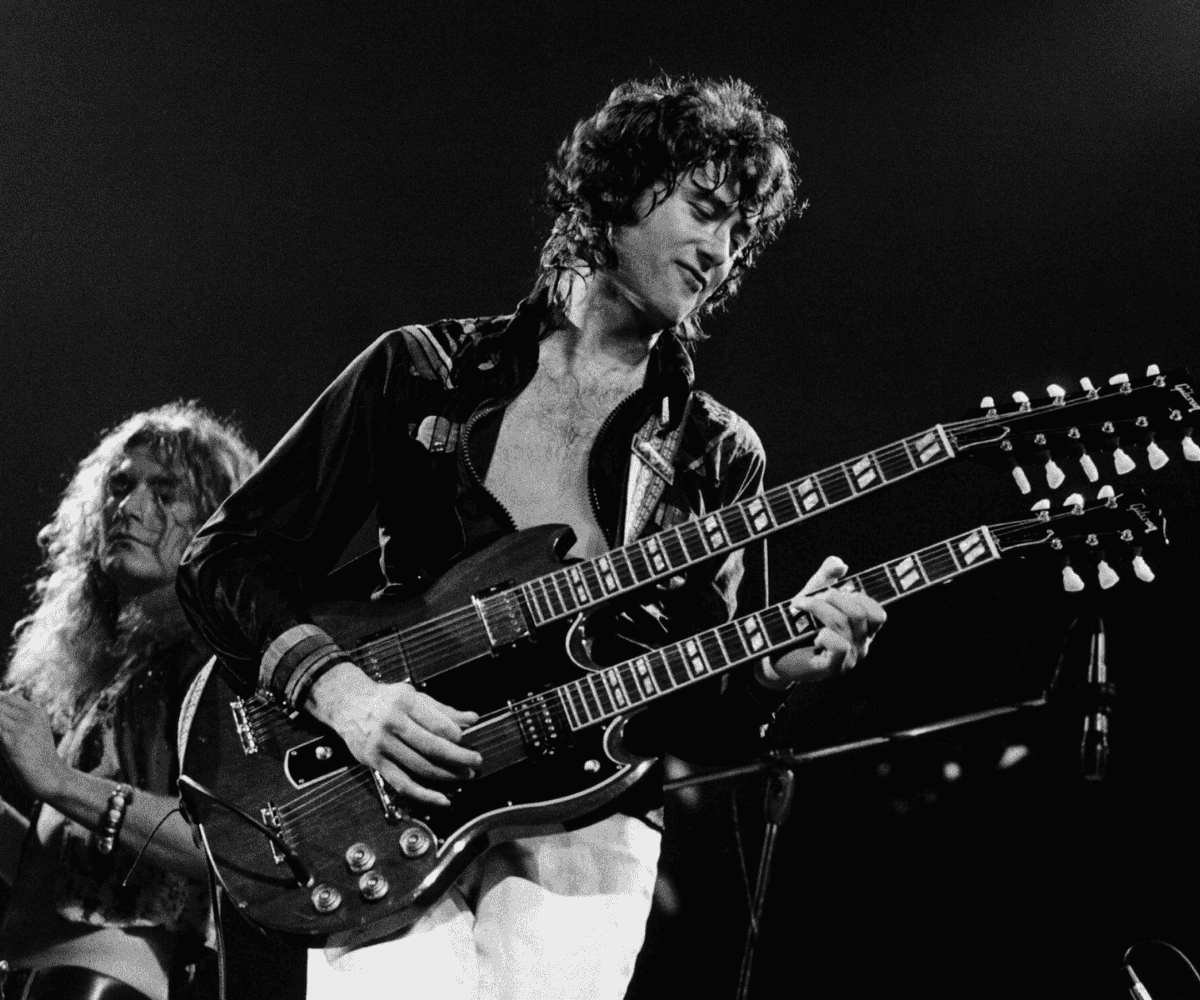
Jimmy Page may be one of rock’s most revered guitar gods, but even during Led Zeppelin’s peak, he carried a deep sense of insecurity—especially when compared to two of his peers: Eric Clapton and Jimi Hendrix. While Page’s contributions helped shape the golden age of guitar-driven rock, he often felt dwarfed by their imperious talent.
Together, Page, Hendrix, and Clapton defined the boundaries of electric guitar in the late 1960s. Yet Page feared that diving too deeply into their work might compromise his own voice. Rather than risk absorbing their styles, he kept his focus locked on Led Zeppelin’s sound. “I thought that if I started to listen to everybody else like Eric and Jimi, then I’d get bogged down with their ideas and start nicking their phrases,” he told NME. “Which I probably did do subconsciously—and I think everybody does.”
Despite intentionally distancing himself from their music, Page couldn’t avoid their presence entirely. Hendrix’s influence, in particular, was inescapable. “You can hear Eric’s phrases coming out on Jimi’s albums,” Page observed, “and you can hear Hendrix phrases coming out on Eric’s records.” It’s a shared legacy—three guitarists innovating at the same time, inadvertently cross-pollinating each other’s work.
While Page respected Hendrix immensely, he regretted never getting to know him personally. They crossed paths only once. “I did actually go into a club in New York called Salvation, and he was there, but he was totally out of it,” Page recalled. “He didn’t really know who anybody was—he was barely conscious. Somebody was just kind of holding him up.”
That brief encounter left Page wishing for more. “It is just kind of a shame that I never really had a chance to talk with him or hear him,” he said. “I heard his records, naturally, but it would’ve been a thrill to see how he worked things out on stage. That’s quite another ballgame, as you know.”
His deliberate avoidance of listening to Hendrix and Clapton wasn’t out of disdain, but a calculated effort to preserve his own originality. “I don’t listen to current guitarists. Whether that sounds right or not,” he once admitted. In hindsight, it seems to have paid off—Page’s style remains as distinctive as any of his contemporaries.
Still, his admiration for Hendrix never wavered. Reflecting on the icon’s untimely death, Page once declared, “We’ve lost the best guitarist any of us ever had, and that was Hendrix.”
Only after the pressure of competition faded could Page fully appreciate the genius of those around him. Today, his respect for Hendrix and Clapton remains undiminished—an acknowledgment from one legend to another, shaped not by rivalry but by reverence.