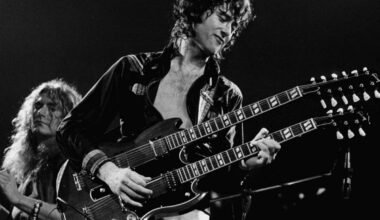

Every generation of rock seems to choose its own voice, no matter what came before. Legends may try to guide the next wave, but in the end, the new guard decides whether to honor the past or break away completely. For Robert Plant, that shift has always been both fascinating and unsettling.
Plant didn’t start out seeking approval from the artists who inspired him. While he knew it would be an honor to receive praise from his heroes, he also understood that rock was about rebellion. His blues-soaked wail — once dismissed as excessive — became the very thing that defined Led Zeppelin, especially when paired with Jimmy Page’s thunderous guitar riffs.
But as the 1980s arrived, Zeppelin’s sincerity gave way to imitation. Hair metal bands may have worshipped them, but Plant saw through the spandex and theatrics, refusing to take their mimicry seriously. When grunge later hit, Zeppelin’s influence was suddenly respected again, and Plant and Page even enjoyed a revival of their own. Yet by the early 2000s, the scene had shifted once more — this time to nu-metal.
Limp Bizkit pushed the rap-rock style to its peak, but when Linkin Park emerged, they felt different. For Plant, however, it was hard to see them as the “future of rock.” He admitted his confusion at the time, once asking: “Linkin Park — is that really what rock became?”
Still, there was something undeniable about Chester Bennington’s voice. Unlike the clichés dominating the charts, Linkin Park carried sincerity. Behind Chester’s screams in songs like “Crawling” or “A Place for My Head” was a raw, authentic pain that connected millions of listeners. Their mix of rock, rap, and electronic elements — though very much of its era — has aged far better than many expected.
While Plant respected other experimental acts like The Flaming Lips, his skepticism toward Linkin Park reflected a larger truth: rock has never been about preserving tradition. Instead, it thrives on breaking rules, bending influences, and channeling emotion into something new. Even if Plant didn’t embrace every step of the genre’s journey, the sincerity at the heart of artists like Chester Bennington kept rock’s spirit alive — just in a different voice.