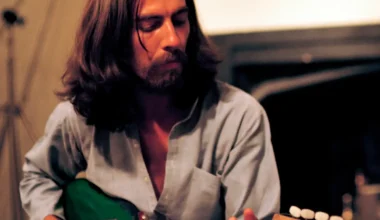

As his time with Pink Floyd neared its end, Syd Barrett had become a shadow of the imaginative force he once was. The founding member’s battle with schizophrenia had taken a serious toll, making it increasingly difficult for him to function—especially in the world of music, which had once defined his existence. Barrett’s deteriorating mental health ultimately led to his exit from the band he helped create.
During the recording sessions for A Saucerful of Secrets, Barrett’s unpredictable behavior became impossible to ignore. He would sometimes miss studio sessions altogether, and even when he did show up, his mental state varied so drastically that his presence became more of a liability than a contribution. This instability prompted the band to bring in David Gilmour, an old friend from Cambridge, to help pick up the slack.
In January 1968, halfway through the album’s production, the band made a quiet but firm decision: they chose not to pick up Barrett for a show in Southampton. That marked the unofficial end of his tenure with Pink Floyd.
Although Barrett’s influence on A Saucerful of Secrets was limited, he left one final mark: the haunting closing track, “Jugband Blues.” It was his last contribution to the band and one that offers a raw, unsettling window into his mental state. With lines like “I’m most obliged to you for making it clear that I’m not here,” the song reads like a farewell from someone painfully aware of his unraveling mind.
In a 2001 interview with John Edginton, Gilmour called the song “very raw” and “brilliant,” describing it as deeply personal and reflective of Barrett’s condition. When asked about Barrett’s songwriting method, Gilmour admitted it was something he never quite understood. “He would just start playing or singing, and it all seemed to pour out of him—as if it was spontaneous,” he recalled. “It felt like he was making it up on the spot, but it probably wasn’t that simple.”
Gilmour speculated that Barrett’s creativity might have come from a subconscious place, noting, “Maybe it was a stream of subconsciousness that he had a unique ability to access.” Despite their closeness, even Gilmour struggled to grasp how Barrett’s mind worked when it came to crafting music.
For all its brilliance, Barrett’s creative flame burned only briefly. His songs—often surreal, playful, and laced with melancholy—offered glimpses into a singular artistic vision. Yet his legacy remains bittersweet, forever clouded by the tragedy of what could have been, had his mental health not taken such a devastating turn.

Michael Thomas
Michael Thomas is a music historian obsessed with the '70s and '80s rock scene. He collects vinyl and argues about Led Zeppelin daily.