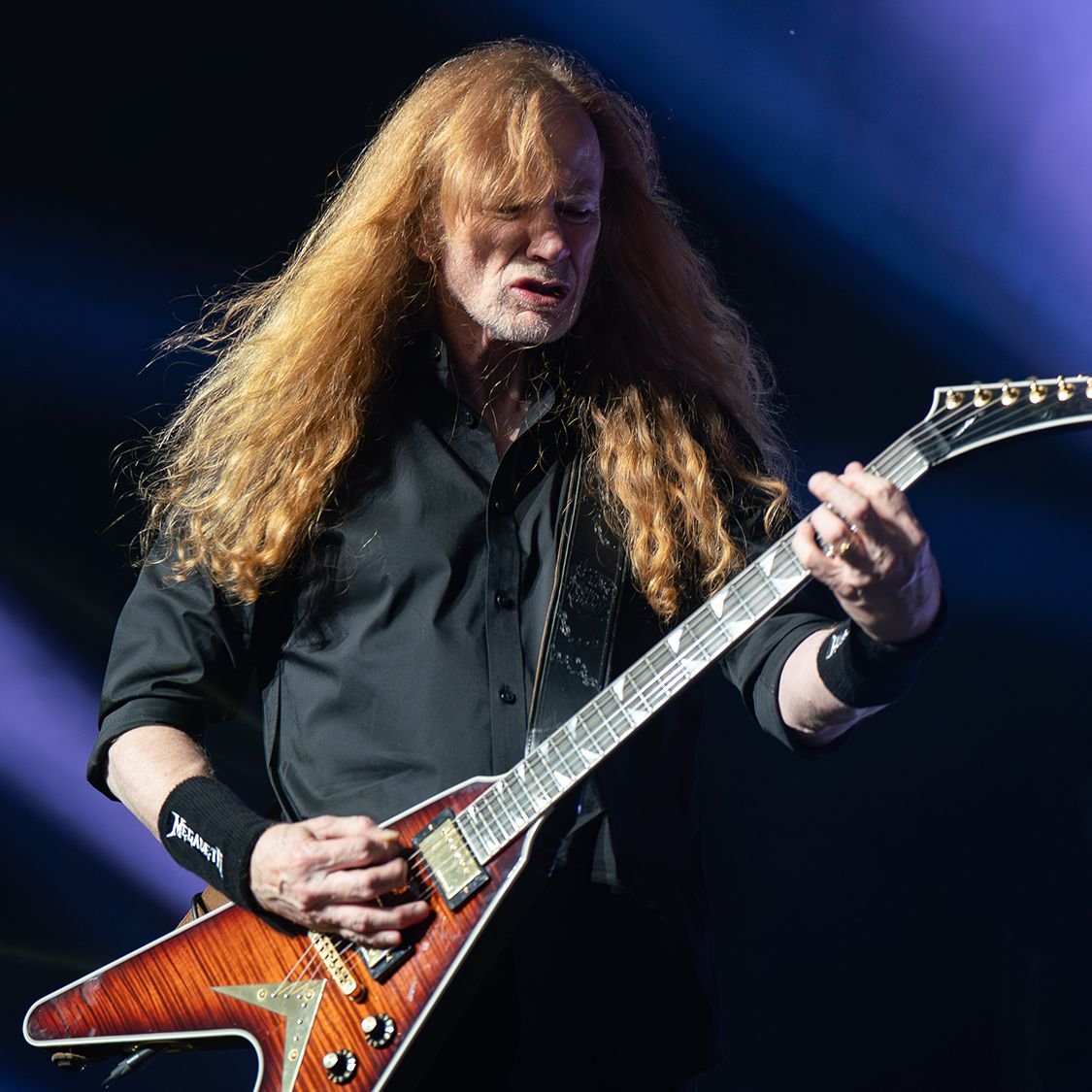
When Dave Mustaine parted ways with Metallica in 1983, he left behind a handful of co-writing credits that would shape the foundation of thrash metal. Decades later, Mustaine has finally reclaimed one of those monumental tracks—the title song of Metallica’s 1984 masterpiece, Ride the Lightning—by recording a brand-new version for Megadeth’s final album, simply titled Megadeth.
While the move might look like a calculated metal power play from the outside, Mustaine reveals it was actually an exercise in deep personal vulnerability, technical guitar legacy, and unexpected vocal strain.
Pushing the Vocal Limits
Stepping up to the microphone to cut his own version of the track gave Mustaine a new appreciation for his former bandmate’s vocal prowess. James Hetfield’s original performance on the 1984 record cast a long shadow, and stepping into those shoes proved to be a brutal wake-up call for the Megadeth frontman.
“It honors James’s playing and singing. He’s a great singer, too,” Mustaine admitted. “Fuck, I was trying to sing that song and some of it really pushed my vocal ability.”
Mustaine noted that while both he and Hetfield possess instantly recognizable voices, their styles are completely different. Breaking down Hetfield’s vocal tracks allowed Mustaine to inject his own distinct musical DNA into the classic arrangement.
Reclaiming the “Spider Chord” and “Grunting”
For Mustaine, recording Ride the Lightning wasn’t just about the vocals; it was a showcase for the specific guitar innovations he brought to the table during thrash metal’s infancy. The track serves as a textbook example of his signature playing styles.
“One of my chords that I invented, the spider chord, where you fret with these two fingers and you fret with these two fingers at the same time and you alternate, that’s in ‘Ride The Lightning,'” Mustaine explained.
He also highlighted a technique he calls “grunting,” where a player hits a guitar chord half a step below the target note and slides directly into it to create a much heavier, aggressive sound. “So spider chords and grunting are in ‘Ride The Lightning,'” he noted.
Healing Old Wounds and Closing the Circle
Despite the historic, decades-long friction between Megadeth and Metallica, Mustaine firmly shut down any rumors that the cover was meant as a shot at his former band. Instead, he views the track as a definitive peace offering and a way to heal.
“It had nothing to do with a ‘gotcha.’ It wasn’t a payback,” Mustaine clarified. “In fact, what it was is me healing a big part of myself because I’ve made peace with what led up to the decisions that we all were forced into and what caused it and what’s happened afterward. It’s been successful and great for everybody.”
Ultimately, Mustaine wanted to ensure the track served as a respectful nod to the musicianship of Hetfield and drummer Lars Ulrich. “The main reason I chose to do this was to close the circle and pay my respects to my partners,” he said. “Anyway, there’s no big strategy; I have respect for the guys, and I just wanted to show that. And it’s a hell of a song.”
Modernizing a Classic
To make the track uniquely Megadeth, the band gave the production a contemporary face-lift. They dialed up the tempo slightly and allowed the individual band members room to flex their muscles. Drummer Dirk Verbeuren was cut loose to beef up the final drum fills, while guitarist Teemu Mäntysaari took on the solo.
According to Mustaine, Mäntysaari’s solo stays close to the original spirit because Kirk Hammett’s 1984 solo was essentially “an improvisation of what I was doing” before exiting the group.