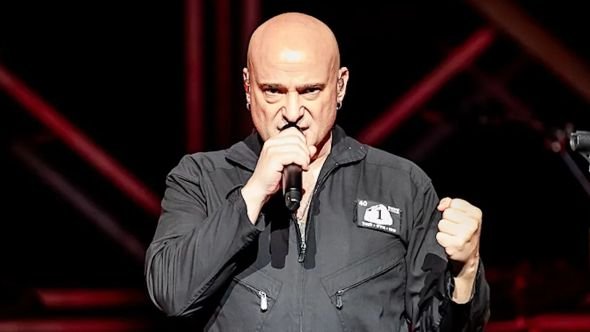
When Disturbed unleashed their staggering cover of Simon & Garfunkel’s classic “The Sound of Silence” in 2015, it completely altered the trajectory of the band’s career. The track broke out of the heavy metal stratosphere, racked up billions of streams, earned a Grammy nomination, and won the ultimate praise from Paul Simon himself.
But beneath the towering, operatic performance that stunned the mainstream world lay a profound layer of anxiety, self-doubt, and literal terror. Frontman David Draiman, usually known for his aggressive, chest-beating nu-metal delivery, had to strip down his armor entirely to record it.
Stepping Outside the Nu-Metal Comfort Zone
The decision to cover the folk classic wasn’t initially Draiman’s idea; his bandmates pushed him to experiment with a softer, more melodic direction. For a singer who built a legacy on rhythmic barking and aggressive grit, exposing his clean vocal register felt incredibly risky.
“I thank you guys for pushing me in this direction,” Draiman later told his bandmates. “I wouldn’t have normally gone there. Personally, I hadn’t heard my voice like that since I was a young man, since I was a teenager.”
Though Draiman had early training as a cantor (a Jewish liturgical singer), he had spent decades burying that style in favor of heavy rock. Going back to those melodic roots forced him into a space of extreme vulnerability.
Battling Severe Self-Doubt
Even after nailing the studio session, Draiman was plagued by intense insecurity. He was terrified of how the public—and his peers—would react to a heavy metal titan singing a delicate ballad.
“I did have major concerns going in,” Draiman confessed. “I remember playing the track for a bunch of my colleagues and friends prior to it coming out, very secretively, and really being unsure. They were like, ‘Don’t be, this is magic. You’ve got lightning in a bottle here.’ I can come off as pretty confident most of the time, but truth be told, I’m my own severe, horrific critic. I can be objective about other people’s music, but when it comes to our own, I’m paranoid as f***.”
When he finally listened to the completed track objectively, the emotional release was physical. “It had been so long since I have allowed myself to go to that place vocally,” he said, recalling how he tore up during the playback. “Hearing it come out as well as I thought it did was not just gratifying, but like having a weight lifted off me.”
The Live Nightmare on National Television
If recording the song was a mental hurdle, performing it live for the first time on Conan in 2016 was a waking nightmare. Backed by a massive 24-piece orchestra, Draiman found himself battling a severe illness right before the cameras rolled.
While the rest of the band casualized the backstage area, Draiman was pacing his dressing room in a cold sweat, physically vocally compromised, and emotionally overwhelmed by nerves.
“Here I am pacing like a maniac, trying to warm up and praying, praying, praying,” Draiman remembered. “Because I was trashed vocally that day. I had no idea how it was going to sound. I tried to shut everybody and everything out, and focus on how I felt about the song and where it was taking me, and not worry about the camera.”
For a frontman who regularly commands festivals of 100,000 screaming metalheads without breaking a sweat, the clinical glare of television changed the entire dynamic. “That red light comes on on a TV camera, I get nervous. Stomach clenches up, it’s a whole different thing. Getting over the level of intimidation was tough.”
The Ultimate Validation
Despite the illness and the crushing anxiety, the Conan performance went viral, solidifying the cover as a modern legendary piece. The ultimate relief came when Paul Simon reached out directly to compliment the band’s rendition.
“When the original songwriter himself gives his blessing and compliments you on what you’ve done… it’s truly overwhelming and incredibly surreal, and a very big shock,” Draiman said. “We couldn’t have hoped for a more positive outcome.”
Draiman’s journey with “The Sound of Silence” proves that true artistry often requires stepping directly into the things that terrify you the most. By acknowledging his paranoia and pushing through vocal vulnerability, he turned a massive creative risk into the biggest victory of Disturbed’s career.